

What Impacts RTK Fix Acquisition? Analysis & Solutions
What Impacts RTK Fix Acquisition? Analysis & Solutions
Introduction
In the field of GNSS surveying, RTK (Real-Time Kinematic) technology has become the industry standard due to its centimeter-level positioning accuracy. However, in practical operations, many surveyors face the frustration of being "unable to get a Fix" or dealing with excessively long initialization times.
The stability of RTK positioning is influenced by a combination of various factors. Let’s analyze the primary elements affecting performance and provide targeted optimization solutions combined with the technical advantages of Apeks GNSS products.
Main Factors Affecting RTK Fix Rate
1.Satellite Signal Quality & Geometry
The primary requirement for an RTK Fix is receiving a sufficient number of satellites with high signal strength.Obstructions: Buildings, dense tree canopies, or mountains not only block signals but also cause Multipath Effects (signal reflection), leading to errors in carrier phase observations.
Spatial Distribution: The more dispersed the satellites are across the sky, the higher the positioning accuracy (lower DOP values).
Impact Factors: Obstacles such as trees, buildings or terrain.
How to Improve:
1.Initialize in open areas whenever possible.
2.Choose a receiver with powerful satellite tracking capabilities (supporting multiple constellations and frequencies) and strong anti-interference performance to enhance signal reception in complex environments.
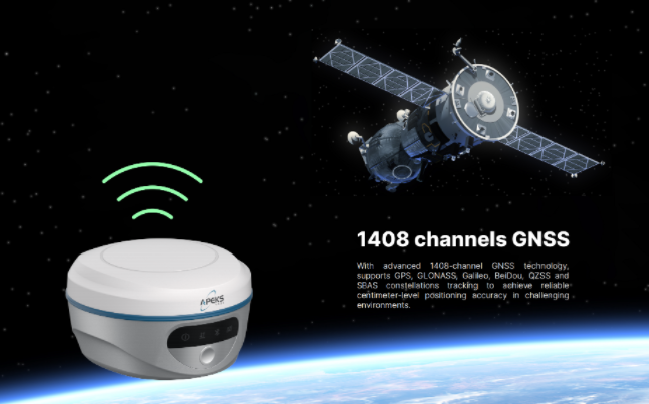
Apeks Advantage: Apeks receivers (such as the AP10) support 1408 channels, capable of simultaneously tracking all-constellation signals including GPS, BDS, GLONASS, Galileo, and QZSS. In obstructed environments, the ability to capture more Beidou-3 satellites allows for a Fix rate increase of over 20% compared to traditional devices.
2.Multipath Effect
When satellite signals reflect off buildings, water surfaces, or metal objects before reaching the antenna, they interfere with the direct signal, causing measurement deviations.
Impact Factors: Areas near urban "concrete canyons," large dams, or metal fences.
How to Improve:
1.Optimize Antenna Placement: Keep the antenna away from tall structures. Ensure the Base station is set up in a high, open area, as Base-end multipath errors are transmitted to all Rovers via correction data.
2.Adjust Mask Angle: Since reflected signals often come from low elevations, raising the cut-off angle from 10° to 15° or 20° can effectively filter out unstable signals reflected from the ground or distant buildings.
3.Extend Observation Time: Multipath errors change as satellite positions shift. When extreme precision is required, increasing static smoothing time allows algorithms to filter out random multipath noise.
Apeks Advantage: Apeks receivers feature highly integrated anti-interference antennas combined with intelligent satellite selection algorithms, which effectively identify and filter out reflected signals to ensure pure observation data.
3.Electromagnetic Interference (EMI)
In power line inspections or industrial zone operations, EMI is the "invisible killer" that prevents RTK Fixes.
Impact Factors: Strong magnetic fields from high-voltage power lines, communication base stations, transformers, or large electric motors can overwhelm weak satellite signals.
How to Improve:
1.Maintain Distance: Stay as far away as possible from transformers and base station towers.
Apeks Advantage: Apeks GNSS utilizes a multi-layer notch filter design, which effectively shields out-of-band interference from 5G base stations and high-voltage electromagnetic fields.
4.Correction Data & Communication Link
The essence of RTK positioning lies in the "real-time dialogue" between the Base and the Rover. If this dialogue is poor quality, delayed, or incomplete, positioning performance will be severely limited.
Impact Factors:
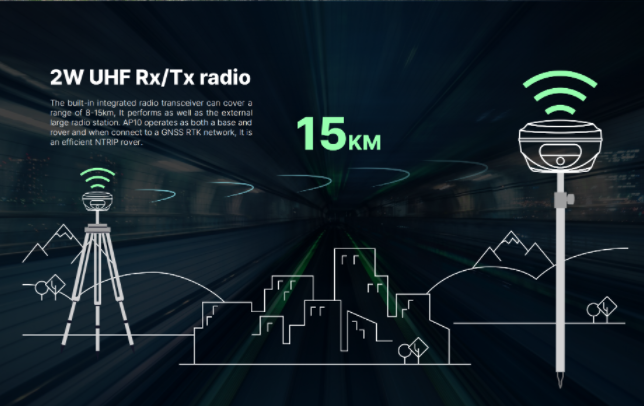
1.Transmission Loss: During long-range operations, radio signals (UHF) attenuate with distance or are blocked by terrain and buildings. In network mode, signal blind spots cause packet loss, leading to a loss of Fix.
2.Long Baselines: When the distance between the Rover and Base exceeds 50km, significant atmospheric differences (ionosphere and troposphere) between the two locations prevent the differential model from fully canceling out errors.
3.Unstable Source: If the Base station is set up in a poorly signal-optimized location, the corrections it broadcasts will inherently contain high noise levels.
How to Improve:
1.Shorten the Baseline: Deploy the Base station within 20km of the work area for optimal solution accuracy.
2.Optimize Transmission Paths: Use high-power external radios in mountainous areas or highly stable 4G/5G networks in urban zones.
Apeks Advantage: Apeks GNSS receivers support various mainstream differential protocols and feature Smart Link technology. When signals are interfered with or brief data loss occurs, internal algorithms predict and compensate for missing correction data. This significantly reduces the difficulty of obtaining a Fix over long baselines and ensures a rapid lock even in complex communication environments.
Conclusion
RTK positioning success is a combination of hardware strength and field experience. Apeks GNSS is dedicated to transforming complex algorithms into simple operations, helping you achieve a "One-Click Fix" in any environment.